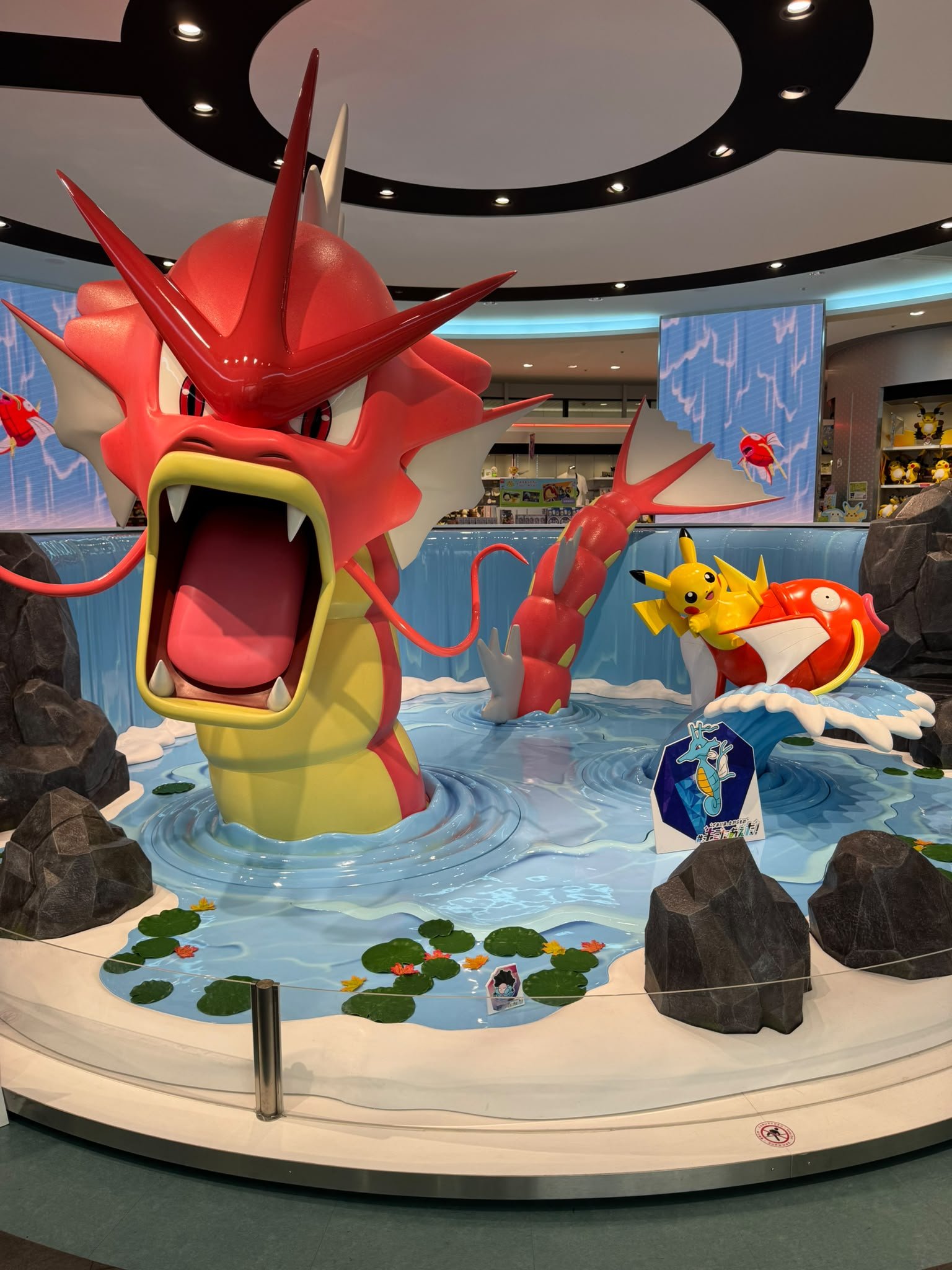
Pokemon Center Hiroshima, Japan
During my recent trip to Japan, I was reminded of just how massive Pokémon has become. Everywhere I went, there were Pokémon Centers, advertisements, merchandise, and stores filled with people searching for cards and collectibles. It made me wonder: what is it about Pokémon that has allowed it to become the highest-grossing media franchise in the world?
After learning a little about the history of Pokémon and its conception, the puzzle pieces start to fit.
Satoshi Tajiri, the founder of Pokémon, was inspired by his childhood hobby of collecting insects in jars. That feeling would later translate into the collection aspect of Pokémon, where trainers fill their Pokédex by obtaining different species. What sets Pokémon apart, though, is the branding they built around it. The designs are simple enough to be cute, powerful, funny, or cool while remaining instantly recognizable. That simplicity opens the franchise to a much wider audience. Other creature-collecting games often rely on intricate, almost anthropomorphic designs. While they can certainly look impressive, they are also harder to adapt into animation and merchandise. Many people who consider themselves Pokémon fans have never even played a Pokémon game, yet still grew up loving the anime.
Looking back, I think that same simplicity is what drew me to Pokémon in the first place. I regularly read National Geographic books and spent a lot of time drawing Pokémon. Somehow, the two complemented each other. One encouraged me to appreciate the natural world, while the other encouraged me to recreate it through art. I don't think I realized it at the time, but both quietly shaped my interest in science.
A valuable takeaway here is that sometimes, less is more. When I began working on research in high school, I imagined it as this long, rigorous process where every concept would be incredibly complex. In reality, many of the ideas reflected what I had already learned in class. For my study on crude oil biodegradation, with the help of the lab and my mentors, we simply compared oil degradation between fungi, bacteria, and a negative control, then measured the change in oil. That was most of the project.
Simplicity is key, and complexity is often an illusion.
